Short answer: Maroo is a layer 1 blockchain for the Korean won economy, built by Hashed Open Finance, and its public testnet is live and free. Add Maroo Testnet to your wallet (chain ID 450815, RPC https://rpc-testnet.maroo.io), claim free tOKRW from the official faucet (5,000 per request), then send your first transaction. Let your wallet estimate gas: a plain transfer needs about 104,000 gas, not 21,000. Maroo has not announced an airdrop or points campaign.
This guide walks through wallet setup, the faucet, a first transfer, a daily GM and a first contract, plus the gas rules that trip up most Ethereum users on Maroo.
We checked every value below against Maroo's docs, website, faucet and RPC on October 23, 2026. Testnets change often. If something differs, trust the official page.
Maroo Testnet in Brief
- What it is: Maroo is Hashed Open Finance's layer 1 for Korean won stablecoins and AI agents, with an EVM layer.
- Network: chain ID 450815, RPC https://rpc-testnet.maroo.io, currency tOKRW (Testnet OKRW).
- Faucet: 5,000 tOKRW per request at faucet.maroo.io, up to 5 requests every 10 minutes.
- Gas: a plain transfer needs about 104,000 gas, so a fixed 21,000 limit fails and is still charged.
- KYC and airdrop: no KYC needed for normal testing, and no airdrop or points campaign announced as of October 23, 2026.
What Is Maroo?
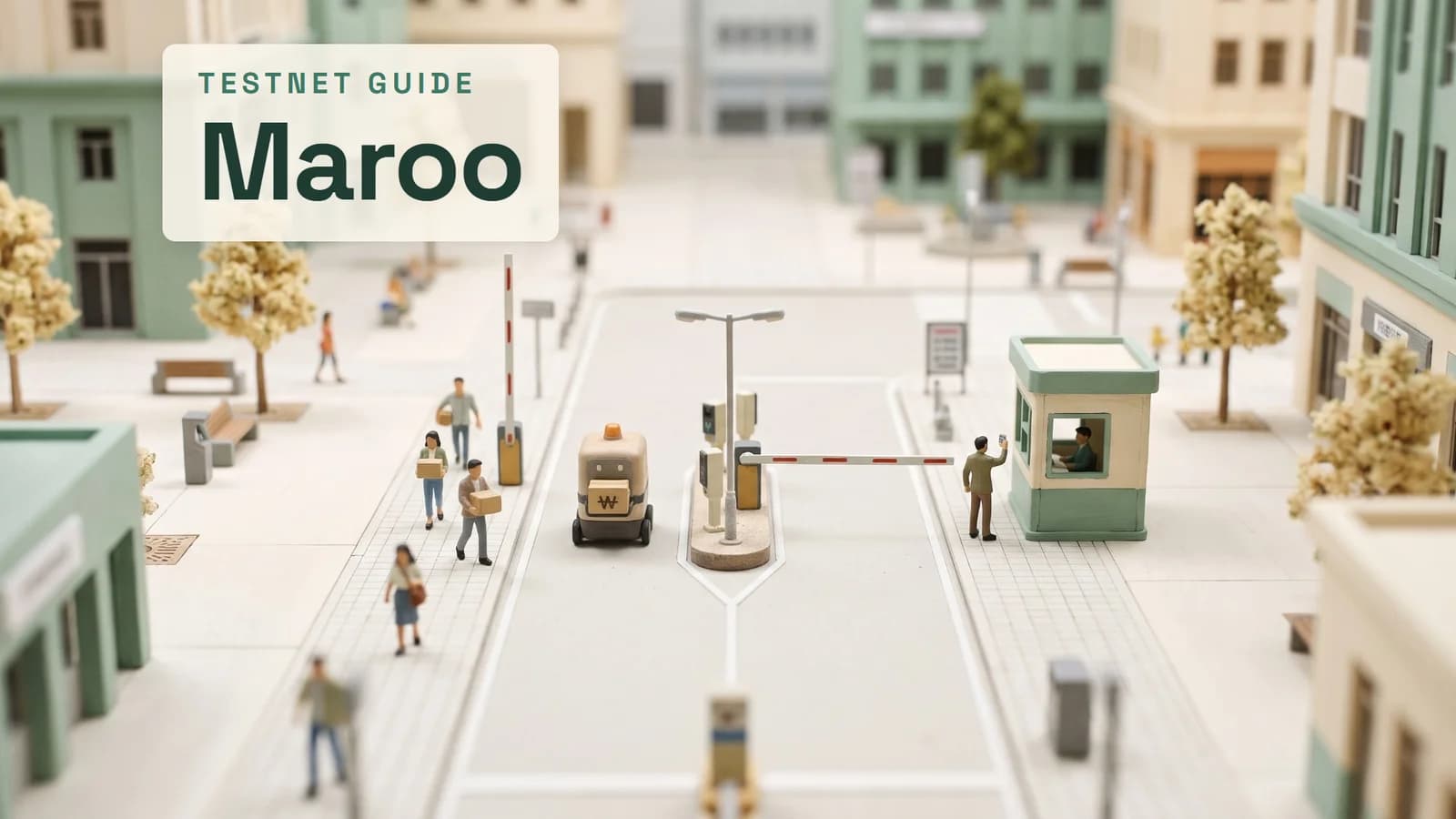
Maroo calls itself "a compliant, open sovereign layer 1 blockchain for the future of the Korean economy". It's built by Hashed Open Finance, Inc., the fintech arm of the Web3 investor Hashed, which opened the public testnet on May 7, 2026. The launch announcement pitched Maroo as a chain where banks, fintechs and AI agents can move won-denominated digital assets.
A few ideas shape how the testnet works:
- OKRW, a won stablecoin, is the gas coin. On the testnet it's tOKRW, and it has no real value.
- Compliance is built into the chain. Maroo's compliance layer (PCL) checks transactions against on-chain policies before they execute. Small, everyday transfers go through the Open Path without KYC. Larger or regulated flows use the Regulated Path with on-chain attestations.
- AI agents are first-class users. Maroo's Agent Wallet Kit gives AI agents account-abstraction wallets with on-chain spending policies, and gas can be sponsored so an agent doesn't need to hold OKRW.
Under the hood Maroo is a Cosmos-based chain with an EVM layer: it has a Cosmos chain ID (maroo-testnet-1) as well as the EVM chain ID your wallet uses. Its docs say Hardhat, Foundry, wagmi, ethers and viem connect without Maroo-specific patches.
Maroo Testnet Network Details
| Category | Value | Notes |
|---|---|---|
| Network name | Maroo Testnet | Any name works in your wallet |
| Chain ID | 450815 | Cosmos chain ID: maroo-testnet-1 |
| RPC URL | https://rpc-testnet.maroo.io | WebSocket: wss://ws-testnet.maroo.io |
| Currency symbol | tOKRW | Testnet OKRW, 18 decimals, no ERC-20 interface |
| Block explorer | https://explorer-testnet.maroo.io | Blockscout-based |
| Faucet | https://faucet.maroo.io/en | 5,000 tOKRW per request, 5 requests per 10 minutes |
| Gas price (Oct 23, 2026) | 9,000 gwei | 8,000 gwei base fee plus 1,000 gwei tip |
| Mainnet | Not launched | Chain ID 815 is reserved for it |
Step 1: Add Maroo Testnet to Your Wallet
Any EVM wallet that supports custom networks works. Maroo's docs use MetaMask. Use a separate wallet for testing if you can, and never reuse a mainnet private key in test scripts.
In MetaMask:
- Open the network menu and choose Add a custom network.
- Enter network name Maroo Testnet, RPC URL
https://rpc-testnet.maroo.io, chain ID 450815, currency symbol tOKRW and block explorerhttps://explorer-testnet.maroo.io. - Save and switch to Maroo Testnet.
Maroo Testnet is also listed in the public chain registry, so some wallets and sites such as Chainlist can add it for you. Compare the chain ID and RPC with the values above before you approve.
Step 2: Get Free tOKRW From the Faucet
- Open the Maroo faucet.
- Select Connect Wallet and approve the connection.
- Request tokens. You receive 5,000 tOKRW.
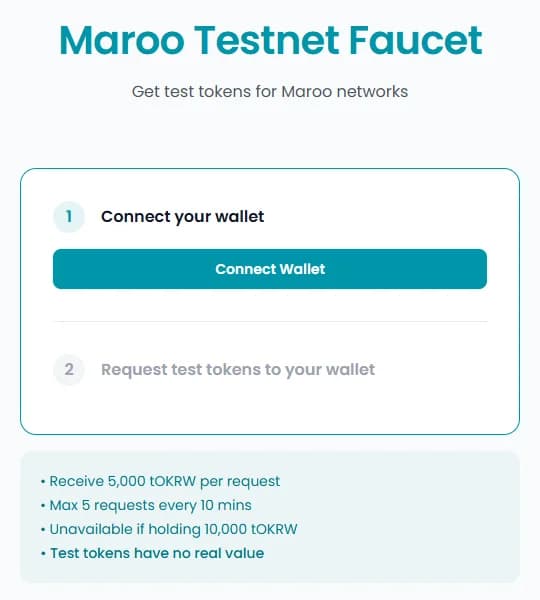
Faucet limits (October 23, 2026): 5,000 tOKRW per request, at most 5 requests every 10 minutes, and the faucet is unavailable once your wallet holds 10,000 tOKRW. In practice you can top up whenever your balance drops below 10,000.
That's plenty. A plain transfer costs under 1 tOKRW in gas, and the PingGM fees below are 1 and 2 tOKRW.
Never share your seed phrase or private key with any faucet, app or "airdrop checker". Maroo's faucet only asks you to connect your wallet.
Step 3: Send Your First tOKRW Transaction
- Make sure Maroo Testnet is the active network.
- Select Send, paste a recipient address (your own second address is fine) and enter an amount.
- Keep the gas limit your wallet estimates. Don't set a fixed 21,000 limit (see the gas section below).
- Confirm, then open
https://explorer-testnet.maroo.io/tx/followed by your transaction hash to check the result.
tOKRW is the chain's native coin, so it shows as your main balance, not as a token. Maroo's docs point out that OKRW has no ERC-20 interface. Apps or scripts that call ERC-20 functions on the placeholder address 0xEeeeeEeeeEeEeeEeEeEeeEEEeeeeEeeeeeeeEEeE move nothing.
Daily Activity on Maroo: Send a GM and Deploy a Contract on PingGM
PingGM supports Maroo Testnet for a daily on-chain GM and a no-code contract deployment, which makes a simple daily habit on the network.
- Go to PingGM and connect your wallet.
- Select the Testnet filter, choose Maroo Testnet and select Send GM. Approve the network switch if your wallet asks.
- Confirm in your wallet. You pay the PingGM fee plus gas, both in tOKRW. On October 23, 2026 the PingGM fee for a GM on Maroo Testnet was 1 tOKRW.
- To deploy a contract without writing code, open PingGM's Maroo Testnet page and use the deployment card on the right, or go straight to the PingGM deployer for Maroo Testnet, then confirm. The PingGM deploy fee was 2 tOKRW.
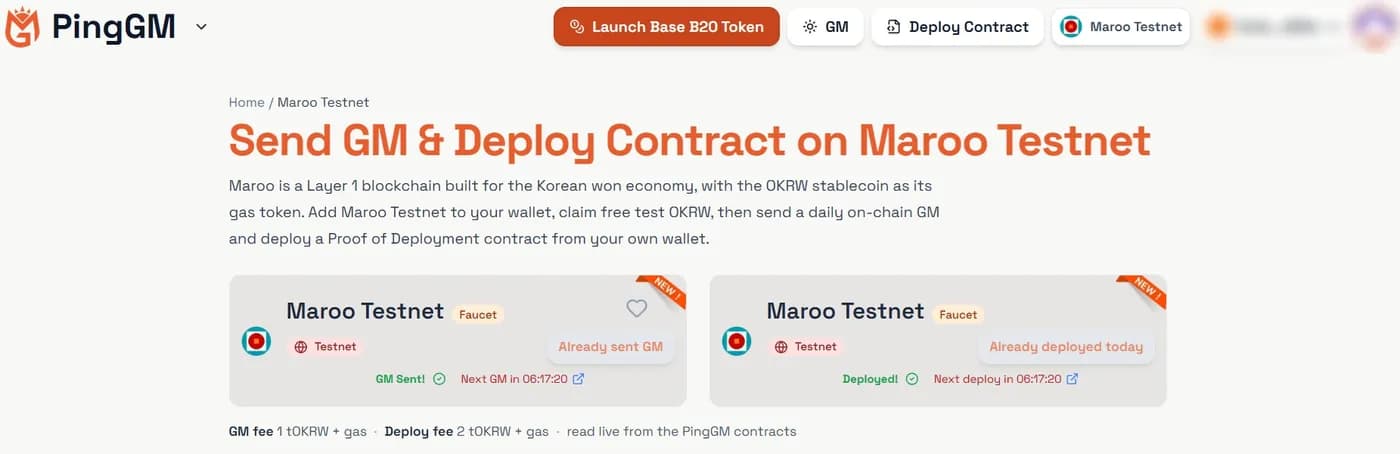
The screenshot shows PingGM's Maroo Testnet page after a GM and a deployment: the buttons read Already sent GM and Already deployed today, with a countdown to the next one, and the current fees are shown under the cards.
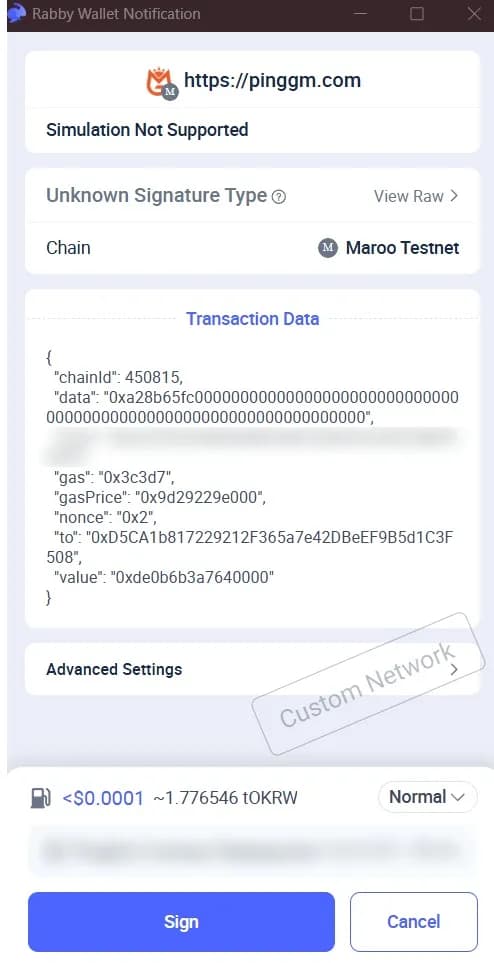
Rabby shows Simulation Not Supported, Unknown Signature Type and a Custom Network stamp because it can't simulate transactions on Maroo Testnet. That's normal for a custom testnet. Check that the chain ID is 450815 and that the value is the PingGM fee: 0xde0b6b3a7640000 is 1 tOKRW. Notice the gas: Rabby set a limit of 246,743 (0x3c3d7) for the GM and estimated about 1.78 tOKRW of gas, so a GM costs under 3 tOKRW in total. Keep the wallet's estimate; as the gas section explains, Maroo needs far more gas than Ethereum.
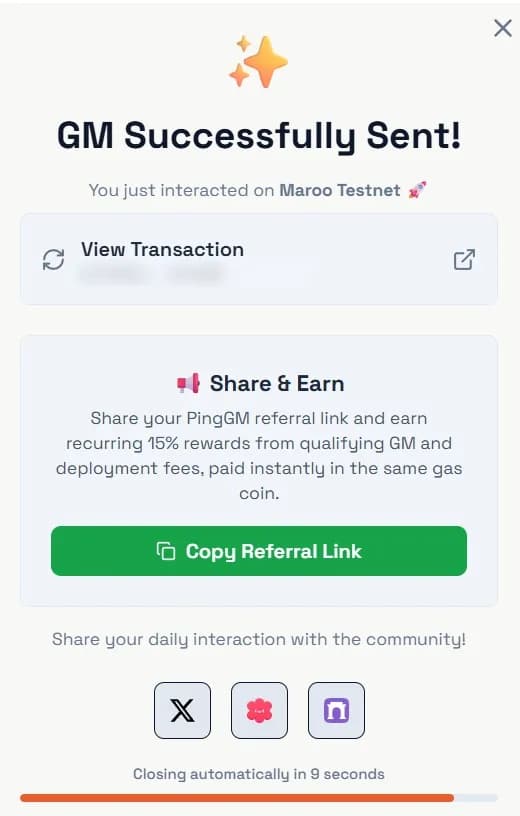
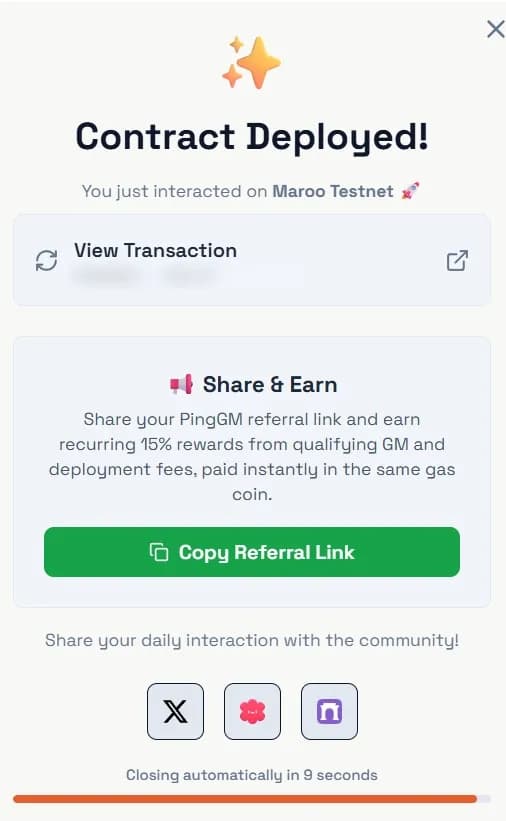
A GM Successfully Sent! dialog confirms it, and View Transaction opens the GM on the Maroo explorer. A deployment ends the same way, with a Contract Deployed! dialog that links to the deployment transaction.
You can send one GM and make one deployment per wallet per UTC day, and both reset at 00:00 UTC. Fees are read live from the PingGM contracts, so check the amount in your wallet before you sign, or see every network's GM and deploy fee. PingGM is non-custodial: you sign every transaction from your own wallet. For how PingGM's deployer works on other networks too, see our guide to deploying smart contracts across multiple blockchains with PingGM.
Is There a Maroo Airdrop? Campaigns, Tasks and Points
As of October 23, 2026, Maroo has not announced a points program, daily check-in, quest portal or airdrop for testnet users. We checked maroo.io, the docs, the faucet and both Maroo apps:
- Maroo Experience is a guided, testnet-based educational experience: sign up, receive a first deposit, then try a transfer, identity verification and fraud protection. Maroo says transfers, identity checks and fund receipts there are scenario-based simulations. It has no points or leaderboard.
- Maroo Agent is a developer kit for AI agents (two MCP servers for reading the chain and running agent wallets). It's a building tool, not a campaign.
So any "Maroo airdrop" or "Maroo points" page you find is not from Maroo unless Maroo links it. Testnet activity doesn't guarantee rewards, and points from any program never guarantee an airdrop. Watch Maroo on X and maroo.io for official announcements. The website doesn't list a Discord or Telegram, so treat community servers using Maroo's name with care.
Gas on Maroo: The Rules That Catch Ethereum Users
Maroo's gas works differently from Ethereum's in ways that can cost you test funds:
- A plain transfer needs about 104,000 gas. Maroo's docs give "about 104,000", and the RPC estimated 103,219 gas for a simple transfer on October 23, 2026. A transaction sent with Ethereum's fixed 21,000 limit is mined, fails and is still charged.
- At least half of the gas limit is charged. Unused gas isn't fully refunded, so don't pad the limit far above the estimate.
- The gas price is high in gwei but cheap in tOKRW. On October 23, 2026 the RPC returned a 9,000 gwei gas price (an 8,000 gwei base fee plus a 1,000 gwei tip). A 104,000-gas transfer at that price costs about 0.94 tOKRW.
- Agent and contract-wallet transfers cost more. Maroo's docs list about 283,000 gas for a transfer from an agent wallet used by one agent, and more when two agents use it.
KYC and Transfer Limits (Open Path)
You don't need KYC to test Maroo. A wallet without an identity attestation uses the Open Path, which caps transfers at 2,000,000 OKRW per transaction and 10,000,000 OKRW per UTC day. Agent-wallet transfers count toward the owner's daily total. A faucet tester never gets close to those limits.
Maroo also runs a testnet KYC service at kyc-testnet.maroo.io. Maroo's docs say it's a real identity check that needs a Korean mobile number and links one wallet per person. Skip it unless you're specifically testing the Regulated Path.
For Developers: Hardhat, Foundry and Viem
Maroo exposes standard Ethereum JSON-RPC, so most projects only need the RPC URL and chain ID 450815.
- Hardhat 3: Maroo's docs say the project must be ESM (
"type": "module"inpackage.json) and must not install@nomicfoundation/hardhat-toolbox. - Gas in scripts: use
eth_estimateGasrather than hard-coded limits. - Native coin: send tOKRW as the transaction
value. Read balances witheth_getBalance, not ERC-20balanceOf. - EIP-712: domains use the EVM chain ID (450815).
- Explorer API: the explorer is Blockscout-based, with its API under
https://explorer-testnet.maroo.io/blockscout/api/v2.
Maroo's testnet access page has config snippets and the deployed contract addresses.
Common Maroo Testnet Errors and Fixes
- Transfer failed but fees were charged: the gas limit was too low (often a fixed 21,000). Resend with the wallet's estimate.
- Faucet says unavailable: your wallet already holds 10,000 tOKRW or more, or you've made 5 requests in the last 10 minutes.
- tOKRW doesn't show as a token: it's the native coin. Check your main balance on Maroo Testnet, not a token list.
- A script's
balanceOfcall throws: OKRW has no ERC-20 interface. Useeth_getBalance. - Transfer blocked by policy: you've hit an Open Path limit (2,000,000 per transaction or 10,000,000 per UTC day). Split the amount or wait for the next UTC day.
- Wrong network: check that your wallet uses chain ID 450815, not mainnet's 815.
Start Using Maroo Testnet
You now have Maroo Testnet in your wallet, free tOKRW and the gas rules that matter. The quickest next step is to send a daily GM on PingGM, then deploy a contract on Maroo Testnet from the same wallet. Each is one wallet confirmation and leaves a real transaction on the Maroo explorer.
The same flow works on other testnets: see our QMS Network testnet guide, SimpleChain testnet guide, DogeOS testnet guide and Base Sepolia faucet guide.
Sources Checked
Last reviewed: October 23, 2026.
- Maroo website
- Testnet Access — Maroo Docs
- Network Access — Maroo Docs
- Getting Started — Maroo Docs
- Sending Your First Transaction — Maroo Docs
- Policy and Compliance — Maroo Docs
- Maroo faucet and Maroo testnet explorer
- Maroo Experience and Maroo Agent
- Maroo Litepaper
- Hashed Open Finance launches testnet of Maroo — press release via The Block (May 7, 2026)
- Maroo on X
- Gas values: read from the public Maroo Testnet RPC on October 23, 2026